
Sensitive factors in refractory material structures - permeability
2025-03-11
The property of a gas permeating a porous body under a pressure difference is called permeability. In a viscous flow regime (Newtonian) gas, the outlet pressure is close to atmospheric pressure, and the permeability of refractory materials with a porosity greater than 5% is determined using cylindrical pores. According to Poiseuille's law, k=Qh/A△p. In the International System of Units, the permeability coefficient is expressed in m3. It is equivalent to a sample with a cross-sectional area of 1m2 and a length of 1m. When the gas volume is 1m3, the viscosity is 1Pa·s, and the pressure difference is 1Pa, the permeability obtained when passing through in 1s. The actual unit used is um2. The calculation formula is:

Where, k20 is the permeability coefficient at 20℃ μm2, Q is the air flow rate through the sample at 20℃ cm3/s; h is the sample height (depth of entry); A is the cross-sectional area of the sample, cm3; △p is the pressure difference between the inlet and outlet of the sample, Pa.
The following calculation obtains the coefficient

Where 108 is the recalculated coefficient, square centimeters in square micrometers: 1.808×10⁻⁵ is the dynamic viscosity of air at 20℃, when the pressure difference △p is greater than 2kPa, the result obtained from formula (9-5) is multiplied by 2(p+p)/(2p+Δp)
Where, p is the pressure of the inlet air, Pa.
Larger permeability corresponds to pore sizes of 20~100um. This level of pore range includes almost all permeable pores. The larger the pore size, the greater the permeability. The structure of the product is very sensitive to permeability. For example, some structural changes lead to a 2-fold change in open porosity, and the permeability changes 100 times. The permeability (Kt) of the product at high temperature is calculated according to the following formula:

Where, K20 is the permeability coefficient according to formula (9-5); n20/nt is the ratio of gas viscosity at room temperature to viscosity at a certain temperature (Figure 9-4). The permeability of all refractory materials (regardless of type) decreases significantly at high temperatures. The permeability at 800℃ is about half that at 20℃.
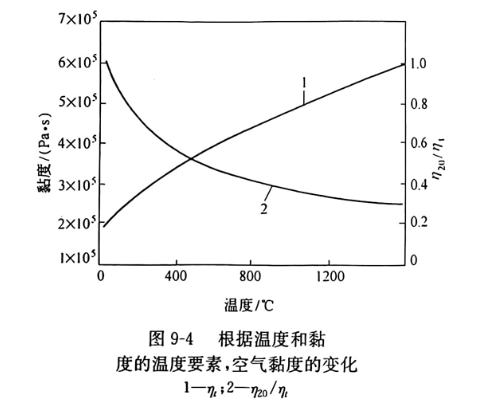
The permeability determined by air permeability is equivalent to the permeability of nitrogen, oxygen, carbon dioxide, and blast furnace gas, because the viscosities of these gases are roughly the same.
The permeability coefficient values of industrial refractory products are in the following ranges: clay (0.2~1.0) μm2, siliceous (0.1~1.2) μm2, magnesia ((0.6~1.2) μm2, chromomagnesia (0.8~2.5) μm2. The permeability of dense products (porosity <5%) is determined in the gas molecular (Knudsen) flow regime. The gas molecular flow regime depends on pressure and channel size. In order for the entire channel to be uniform, the size is less than 103μm channel gas flows in the molecular regime, and the gas pressure should be 1.33Pa and lower. During molecular flow, the product structure gives the airflow less resistance, so when the structural parameters are the same,

Previous Page:
Feedback
Leave a message now, and we will arrange for a specialist to contact you as soon as possible.

HENAN SINO INDUSTRIAL REFRACTORY NEW MATERIAL CO. LTD
Factory Address:
Mazhai, Zhengzhou, China
Nanlou, Dashiqiao, China
Xinmi, Zhengzhou, China
Samut Sakhon, Thailand
Klang ,Malaysia


Copyright © Henan Sino Industrial Refractory New Material Co. Ltd
Privacy Agreement Supports IPV6 SEO