
Different properties and applications of bonded silica in refractory materials
2025-03-21
(I) Bonded silica
1. Quartz sandstone
Quartz sandstone, also known as siliceous sandstone, belongs to bonded silica and is a type of mechanical sedimentary rock. The rock consists of two parts: clasts and cement. The clast part is mainly composed of quartz grains, accounting for more than 90%. In addition, there are a small number of aluminosilicate minerals, such as feldspar and mica, with a total amount of 1%~2%, not exceeding 4%~5%, and trace amounts of chert and carbonate minerals are also mixed in. The cement is mostly siliceous, sometimes carbonate, ferrous, etc. According to the type of cement, it can be divided into: siliceous quartz sandstone, calcareous (dolomitic) quartz sandstone and ferruginous quartz sandstone.
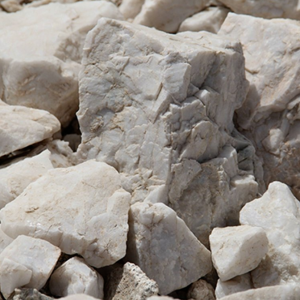
The chemical composition of quartz sandstone is mainly SiO2, generally more than 95%, followed by Al2O3 <1%~3%, Fe2O3 <1%, MgO <0.1%, CaO <0.6%, Na + K2O <1%~2%. Pure quartz sandstone is white or grayish white; generally due to the mixing of certain impurities, it is light yellow or light red; when the cement type is ferrous cement, it is brown. The quartz grains in the rock are often well-rounded, uniform in size, with coarse grains (0.5~1mm) and fine grains (0.1~0.25mm).
The cross-section of the rock is rough, and quartz grains can be seen with the naked eye. However, sometimes the siliceous (chalcedony, opal, etc.) cement of quartz sandstone can crystallize secondary growth on the clast particles, in which case it is difficult to distinguish the particles and cement with the naked eye. It has high refractory properties and can reach 1700℃.
Due to the many impurity components in quartz sandstone, the density is poor, the strength is low, and the quartz particles are small, the crystal phase transformation of silicon dioxide is faster during firing, and it is easy to loosen after firing. However, it can be used to make general silica bricks, and also as a raw material for glass.
There are high-quality and large-scale quartz sandstone deposits in Qinhuangdao, Hebei, Tongliang, Sichuan, Xiangtan, Hunan, and Gedian, Hubei.
2. Chert
Chert is a type of siliceous rock, mainly composed of chalcedony, quartz or opal, the main component is SiO2, and also contains impurities such as Al2O3, Fe2O3, CaO, MgO, KO, Na2O, with fine particles, mostly sub-angular, and high hardness.
The composite silica (also known as red and white silica) in Wutai Mountain, Shanxi Province, China belongs to both this type and bonded silica. This composite silica contains uniformly fine dispersed iron-containing minerals and fine quartz grains, and SiO2 is easy to transform during heating.
3. Quartz sand
Quartz sand, also known as silica sand, is composed of the weathered debris of quartzite, quartz sand, vein quartz and rocks with high silicon content, which are transported by water and deposited in coastal areas, lakes and rivers. The main mineral of quartz sand is quartz mineral, accounting for more than 95%, and also contains a small amount of feldspar particles (5%) and a very small amount of heavy minerals and organic matter. The quartz particles are uniform in size, smooth surface, good roundness and sorting, and the particle size is between 0.15~0.5mm. Pure quartz sand is white, and due to the presence of iron, it is often light yellow, light gray or brownish red. Its chemical composition fluctuates greatly, mainly SiO2 (more than 90%), Al2O3 (<5%), Fe2O3 (<1%), and also TiO2, Cr2O3, K2O, Na2O3.
Quartz sand can be used as a raw material for general silica bricks and is mostly used as a ramming material.
China has high-quality quartz sand in Jiangsu (Donghai), Shandong, Jilin (Ganqika), Guangdong (Xinhui, Zhuhai), Hunan and other places. Among them, Donghai quartz sand in Jiangsu is made from Donghai quartz processing, with high SiO2 content and low impurities, which is a raw material for producing fused quartz, glass products, ceramics, and refractory materials. Its chemical composition is: SiO2≥99.8%, Fe2O3≤0.015%, Al2O3≤0.025%, Na2O≤0.003%, CaO≤0.005%.
Feedback
Leave a message now, and we will arrange for a specialist to contact you as soon as possible.

HENAN SINO INDUSTRIAL REFRACTORY NEW MATERIAL CO. LTD
Factory Address:
Mazhai, Zhengzhou, China
Nanlou, Dashiqiao, China
Xinmi, Zhengzhou, China
Samut Sakhon, Thailand
Klang ,Malaysia


Copyright © Henan Sino Industrial Refractory New Material Co. Ltd
Privacy Agreement Supports IPV6 SEO